Mobile Proxies for Social Media Management: Account Safety, Detection, and Setup
Every major social platform correlates IP addresses, device fingerprints, and session behavior to detect coordinated activity. This post covers how detection works, why mobile proxies carry higher trust than other proxy types on social platforms, and how to configure sessions correctly for account safety.

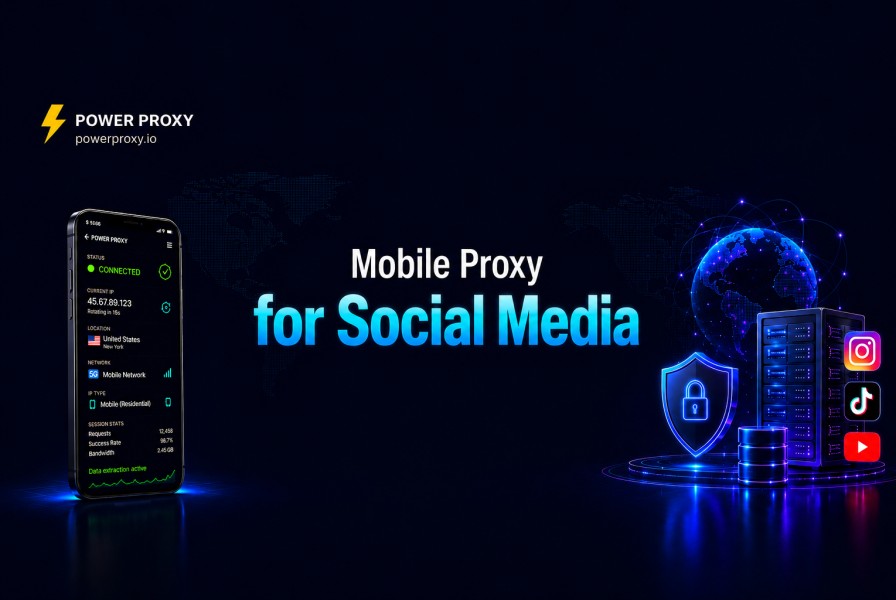
Managing multiple social media accounts from a single connection is one of the fastest ways to trigger a platform ban. Every major network correlates IP addresses, device fingerprints, and session behavior to identify coordinated activity. When several accounts connect from the same IP, the platform does not need much else to flag them.
Mobile proxies address this at the network level by routing each connection through a real 4G or 5G carrier IP, the same type of address used by millions of real smartphone users every day. This post covers how platform detection works, why mobile IPs carry higher trust than other proxy types for social media, and how to configure sessions correctly for account safety.
How Social Media Platforms Detect and Flag Accounts
Running more than two or three accounts from one connection is enough for most platforms to notice. Detection is layered, and IP matching is only the first layer.
Platforms score IP ranges by type. Datacenter and VPN ranges carry lower trust. Multiple accounts from the same subnet get linked even when individual IPs differ.
Screen resolution, fonts, WebGL, timezone, language. Two accounts sharing the same fingerprint are linked regardless of IP. This layer often carries more weight than IP signals.
Login times, posting cadence, scroll patterns, interaction sequences. Accounts with robotic schedules get flagged even on clean IPs with unique fingerprints.
The Scale of Platform Enforcement in 2026
Surfshark research published in March 2026 aggregated figures from various platform transparency reports. These figures cover a range of violation types and should be read as order-of-magnitude indicators rather than precise annual counts, since platforms use different definitions and reporting periods.
These figures are order-of-magnitude indicators. What the data consistently shows is that coordinated inauthentic behavior is treated seriously at scale, and that running multi-account workflows without proper infrastructure is increasingly fragile.
Why Mobile Proxies Have Higher Trust on Social Media
CGNAT and the False Positive Problem
Mobile carriers assign IPs through Carrier-Grade NAT, which means a single public IP can represent thousands of real users simultaneously. When a platform sees a mobile carrier IP, blocking it carries a meaningful risk of affecting legitimate customers. This is one reason platforms apply broader tolerance thresholds to mobile carrier ranges, though this tolerance is not absolute and does not override behavioral or fingerprint signals.
Mobile vs Residential vs Datacenter for Social Media
Carrier IPs shared via CGNAT. Platforms cannot block without collateral damage to real users. Best fit for Instagram, TikTok, and high-value accounts.
Real ISP consumer IPs. Working standard for most multi-account social media operations. Avoid on platforms with aggressive mobile-first detection.
Identifiable server ranges. Avoid for any workflow involving account logins on social platforms. Suitable for public scraping without login only.
Because TikTok and Instagram are mobile-first platforms, carrier-network traffic aligns more closely with normal user behavior than datacenter traffic. Datacenter proxies should be avoided for any task involving account logins on these platforms.
What Social Media Managers Can Do with Mobile Proxies
Managing Multiple Accounts Without Bans
The primary use case is account isolation. Each account receives a dedicated mobile proxy IP, and that pairing stays fixed. This builds a consistent login history per account, which platforms read as normal individual user behavior. Most professionals working at scale recommend dedicating specific proxies to specific accounts rather than rotating accounts across proxies, in order to establish consistent behavioral patterns that platforms recognize as legitimate.
The goal is not simply to use a different IP per account, since real users regularly change networks, travel, and switch between WiFi and mobile data. What platforms look for is anomalous patterns: multiple accounts logging in with identical behavior from the same connection, or coordinated activity that does not match how individual users actually behave.
Geo-Targeted Content and Competitor Research
Social platforms personalize results, trending topics, and ad delivery based on location. Mobile proxies with geo-targeting let social media teams see how content performs in specific cities or countries, monitor how competitors appear in different markets, and verify that localized campaigns are serving correctly.
Account Warm-Up and Recovery
New accounts and accounts recovering from a restriction benefit from a clean IP with a stable history. Mobile carrier IPs tend to produce fewer friction signals during warm-up than datacenter ranges. During warm-up, the account connects from the same dedicated mobile IP in every session, building a consistent login record before activity levels increase.
Warm-up rule: Changing the IP mid-warm-up, or starting warm-up on one proxy and switching to another, creates history inconsistency that risk scoring systems notice. Keep the same dedicated IP throughout the full warm-up period.
How to Configure Mobile Proxies for Social Media Account Safety
Give each account its own dedicated IP and keep that pairing consistent. When each account consistently connects from its own assigned IP, it builds an independent connection history over time, which makes coordinated activity harder to detect through IP-based clustering.
For social media account management, sticky sessions are preferable to rotating sessions. A sticky session keeps the connection pinned to the same device and IP for a defined window. Rotation is designed for scraping workloads that require no login state, not for account management.
If an account presents as a business in a specific country, its proxy IP should resolve to that country. A mismatch between stated location and connection origin is a standard detection signal across all major platforms.
Mobile Proxy Setup by Social Media Platform
Meta's ecosystem shares tracking data across Instagram, Facebook, WhatsApp, and Messenger. An issue on one property can affect accounts across all of them. Both platforms were built around mobile-first usage. Longer sticky sessions are advisable for Instagram: frequent unexplained IP changes contribute to risk signals, especially when combined with other anomalies.
One of the more sophisticated multi-account detection systems among major platforms. TikTok invested over $2 billion in trust and safety in 2024. Cross-references IP history across sessions. Mobile proxies produce fewer friction signals than residential or datacenter alternatives, but TikTok's detection relies heavily on device fingerprinting and behavioral clustering alongside IP signals.
Applies a trust scoring system weighing IP quality, session consistency, and behavioral patterns. Used primarily by B2B agencies running outreach across multiple client profiles. One dedicated IP per profile, sticky sessions for the working session length, and geo-matching to the account's stated location.
Removed around 671 million accounts in 2024 according to aggregated transparency report data. Applies IP reputation scoring alongside behavioral analysis. Dedicated mobile proxy per account with consistent geo-matching is the standard setup for multi-account management on this platform.
What Mobile Proxies Do Not Cover
A mobile proxy addresses the network identity layer of a connection. It does not change the browser fingerprint, the device attributes, or the behavioral patterns of the account using it.
Browser Profiles and Fingerprint Isolation
For teams managing multiple social media accounts, separate browser profiles address an equally important layer: device and browser fingerprinting. Modern platforms collect canvas fingerprints, WebGL data, installed fonts, screen resolution, language settings, and timezone. When multiple accounts share the same browser fingerprint, platforms can associate them even when different proxy IPs are used.
Many social media managers combine dedicated mobile proxies with separate browser profiles to isolate both network and device-level signals. The proxy handles the IP. The browser profile handles the fingerprint. Both need to be consistent per account for the setup to hold under scrutiny.
Important: Mobile proxies are often used as part of professional multi-account setups, but they are only one component of a broader account management strategy. Fingerprint isolation tools and consistent behavioral patterns are required alongside proxy infrastructure.
Dedicated Mobile Proxies for Social Media Management
Power Proxy provides dedicated 4G and 5G mobile proxies on Vodafone's network, with sticky session support, country and city-level geo-targeting, and HTTP, SOCKS5, and OpenVPN compatibility. One device per account, no shared bandwidth.
Narmin Kamilsoy
Contributing author sharing insights and stories on our blog.