Mobile Proxies for AI Agents
Mobile proxies have become a core part of modern AI agent infrastructure. This guide covers why bot detection blocks automated traffic, how CGNAT-based mobile IPs reduce block rates, and how to connect proxy infrastructure to LangChain, Playwright, and Python-based agent frameworks.

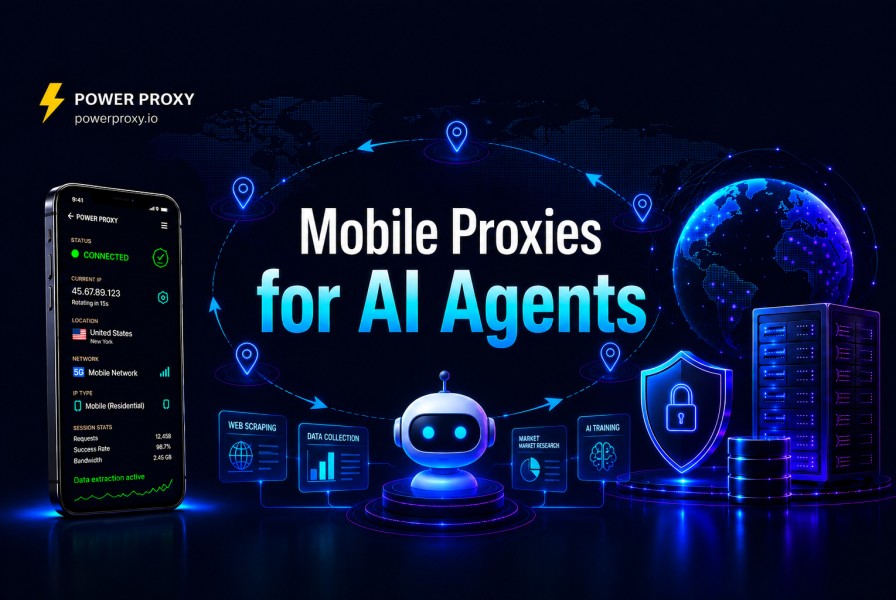
AI agents are not a research concept anymore. They browse websites, collect data, fill out forms, monitor prices, manage social media accounts, and run multi-step workflows across the open web, often without any human input between steps. Frameworks like LangChain, LangGraph, Browser Use, and OpenAI Operator have made it practical to build autonomous AI agents that act at scale.
But most developers hit the same wall quickly. The web was not designed for non-human traffic, and modern anti-bot systems are getting better at detecting automated requests, regardless of how capable the agent logic is. Even the most capable agentic AI will fail consistently if its network identity keeps getting flagged. It also needs a trusted IP layer that reduces the likelihood of IP-based detection in the first place.
Mobile proxies have become a core part of modern AI agent infrastructure, providing the network layer autonomous agents need to access the web reliably. They provide real carrier-assigned IP addresses that originate from mobile carrier networks rather than datacenters, which generally gives the traffic a more trusted network identity than datacenter IPs. This guide covers why mobile proxies are the right infrastructure choice for AI agent deployments and how to connect them to the most common agent frameworks.
What Is an AI Agent and Why Does It Need a Proxy?
The Difference Between a Chatbot and an AI Web Agent
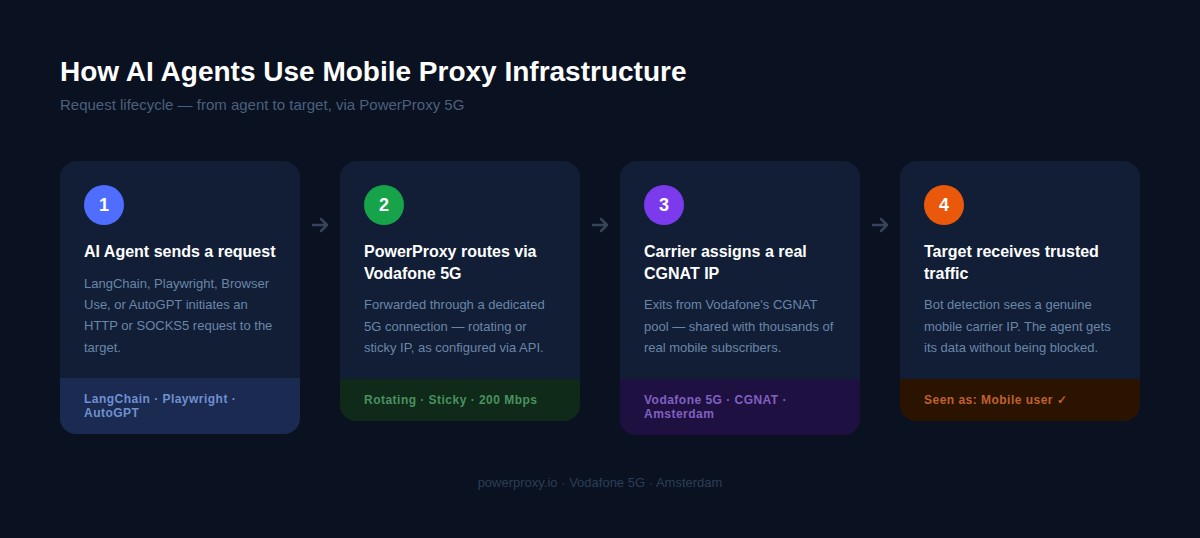
A chatbot responds to input within a conversation window. An AI web agent goes further: it takes a goal, breaks it into steps, decides which tools to use, executes those tools, observes the results, and continues until the goal is reached. For most practical use cases, that means making requests to live websites and APIs without a human in the loop.
An agent researching competitor pricing navigates there directly. An agent monitoring SERP rankings fetches Google search results on a schedule. An agent handling social media management logs in, reads notifications, and posts content. Every one of those actions generates network traffic that websites actively monitor for bot-like patterns.
Why Agentic AI Makes Web Requests at Scale
Unlike a human browsing a few pages per session, an AI agent can generate hundreds or thousands of requests as part of a single task. A RAG pipeline refreshing a dataset hits dozens of URLs per run. A price monitoring agent checks product pages across multiple markets on a continuous basis. A browser agent managing multiple accounts sends requests across sessions simultaneously.
This volume is exactly what anti-bot infrastructure is built to catch. A single IP generating frequent, pattern-like requests to the same domain is a clear signal to systems like Cloudflare, DataDome, and Akamai. Without a proxy layer, even well-built AI automation hits blocks within minutes at production scale.
The Core Problems AI Agents Face on the Web
Bot Detection and IP Blocking
Modern bot detection evaluates far more than user-agent strings. It looks at TLS fingerprints, HTTP/2 header order, behavioral patterns, and IP reputation. According to the Thales 2026 Bad Bot Report, automated traffic accounted for 53% of all internet traffic in 2025, with bad bots making up 40%. As a result, anti-bot vendors have raised their detection sensitivity significantly.
Many anti-bot systems assign higher risk scores to traffic originating from well-known datacenter IP ranges before behavioral analysis even takes place. Mobile proxy IPs sit in carrier-assigned ranges shared among large numbers of legitimate mobile subscribers, which generally gives them a stronger IP reputation. For a deeper look at how this reduces IP bans specifically, see our post on how mobile proxies reduce IP bans.
Rate Limiting and Request Throttling
Rate limiting systems track requests per IP over a time window. When an AI agent sends multiple requests quickly from the same address, it hits these thresholds and receives 429 responses or gets served degraded content without warning. Rotating across a pool of mobile proxy IPs spreads the request load so that no single IP accumulates enough requests to trigger throttling.
Geo-Restricted Content
Prices, search results, product availability, and ad creative all vary by location. An AI agent checking search rankings in Germany needs to send requests from a German IP to see the same results a German user would. Mobile proxies with geo-targeted carrier IPs make this possible without separate infrastructure per region.
Session Continuity Across Multi-Step Tasks
Many AI agent workflows are not single-request tasks. Logging into an account, navigating to a page, taking an action, and logging out is a multi-step session that must use the same IP throughout. Switching IPs mid-session is treated as suspicious by most platforms and often triggers security checks or forces re-authentication. Sticky session support is a core requirement for agents handling authenticated or stateful interactions.
Why Mobile Proxies Outperform Other Proxy Types for AI Agents
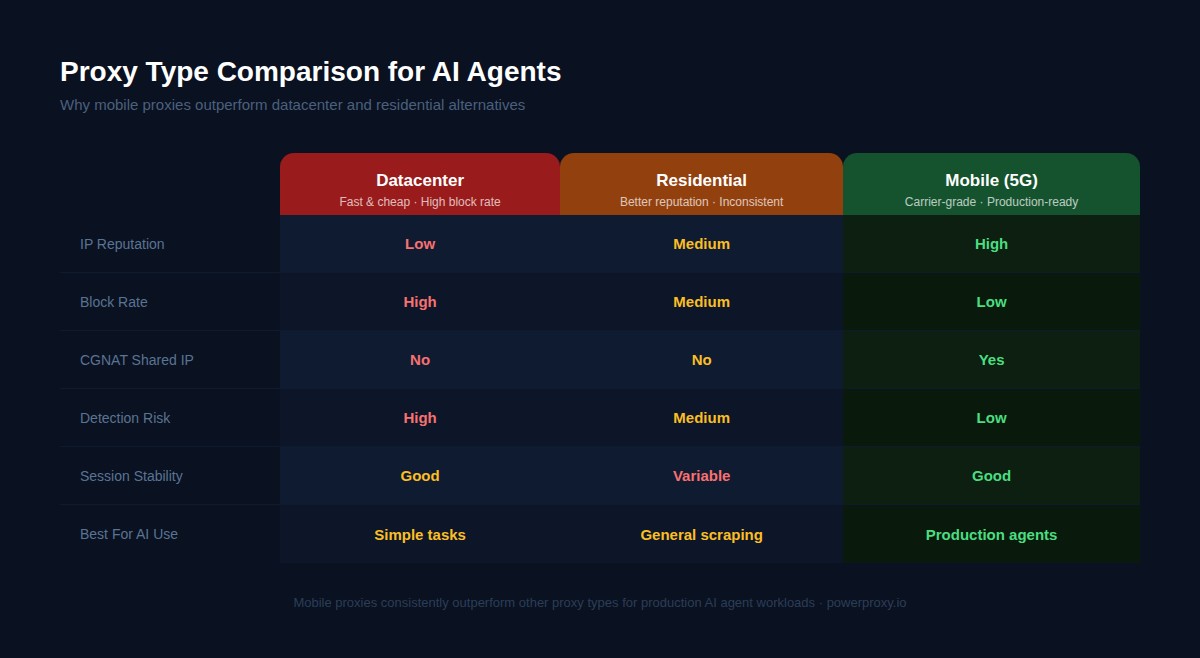
Datacenter proxies fail quickly at production scale because their IP ranges are well-documented in reputation databases. Residential proxies are more trusted but can have inconsistent quality and variable compliance considerations depending on how the network is sourced. Mobile proxies use real cellular connections through dedicated hardware such as phones, modems, or SIM gateways, with IPs coming from carrier-assigned pools. For a full breakdown of how these proxy types compare, see our residential vs mobile proxy comparison.
Mobile carriers share a single public IP among large numbers of subscribers simultaneously through Carrier-Grade Network Address Translation (CGNAT). Blocking a heavily shared CGNAT IP also affects many legitimate users, so websites are less likely to apply blanket blocks to these ranges compared to dedicated datacenter IPs. This structural property gives mobile proxy IPs a stronger reputation baseline for high-volume AI agent workloads.
Key Use Cases: Where Mobile Proxies Power AI Agent Workflows
Continuously fetch and index pages for retrieval-augmented generation systems without hitting rate limits or accumulating bans on key sources.
Monitor competitor prices and inventory across markets with geo-targeted mobile IPs that bypass aggressive retail anti-scraping systems.
Assign a dedicated sticky-session mobile IP per account so each account maintains a stable network identity throughout its session.
Full guide: Mobile Proxies for Social Media →Track organic rankings and AI Overview appearances across regions by routing queries through carrier IPs in each target market.
Rotating vs Sticky Sessions for AI Agents
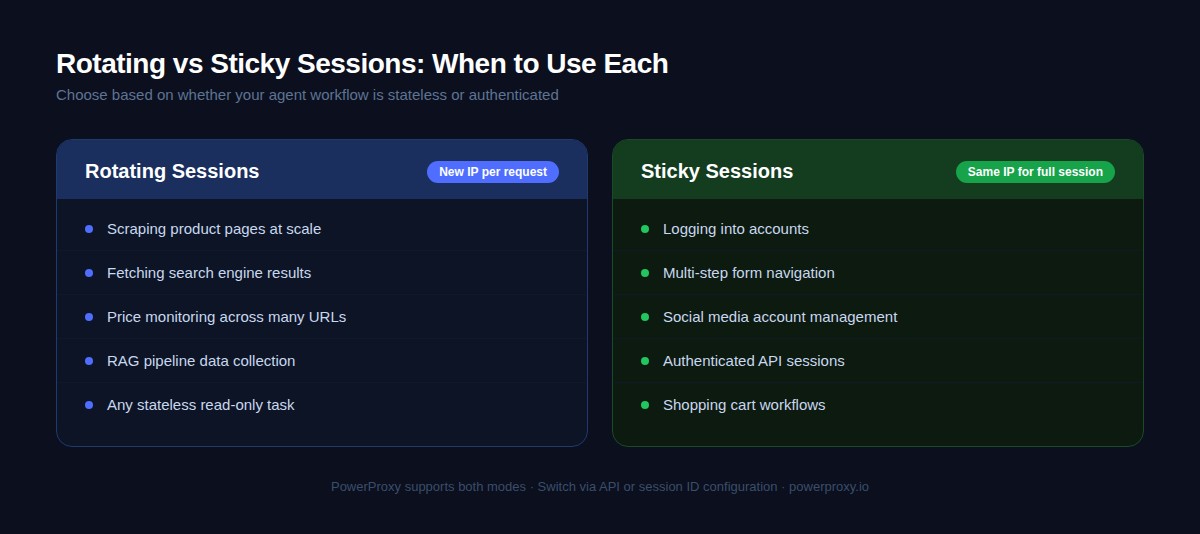
Per-request rotation works well for stateless tasks: scraping product pages, fetching search results, collecting publicly available content across many URLs. Sticky sessions keep the same IP for a defined period and are essential for authenticated workflows: logging into accounts, navigating multi-page forms, managing social media sessions. Switching IPs mid-session triggers security alerts on most platforms. For a full technical breakdown, see our post on how mobile proxy rotation works.
How to Connect a Mobile Proxy to Your AI Agent
Most mobile proxy providers expose their service through a standard HTTP or SOCKS5 endpoint with username and password authentication. Connecting an agent framework to this endpoint is straightforward in most cases.
Python Setup with Requests or HTTPX
For agents making direct HTTP requests in Python:
import requests

proxies = {
    "http":  "http://user:[email protected]:PORT",
    "https": "http://user:[email protected]:PORT"
}

response = requests.get("https://target-site.com", proxies=proxies)
# For SOCKS5: use socks5://user:[email protected]:PORT
LangChain and LangGraph Integration
LangChain's web-facing tools respect system-level proxy environment variables:
import os

os.environ["HTTP_PROXY"]  = "http://user:[email protected]:PORT"
os.environ["HTTPS_PROXY"] = "http://user:[email protected]:PORT"
os.environ["NO_PROXY"]    = "localhost,127.0.0.1"

# Covers: DuckDuckGoSearchRun, WebBaseLoader,
# AsyncHtmlLoader, RequestsGetTool
For production agents running concurrent threads, use a pool with multiple proxy ports so each thread has its own endpoint without sharing a single connection.
Browser Agents: Playwright and Puppeteer
Browser-action agents that drive a real Chromium instance configure the proxy at browser launch:
from playwright.async_api import async_playwright

async with async_playwright() as p:
    browser = await p.chromium.launch(proxy={
        "server":   "http://proxy.powerproxy.io:PORT",
        "username": "user",
        "password": "pass"
    })
# Same port throughout = sticky session
# Relaunch context between tasks = rotation
Responsible Use: Compliance and Ethical Considerations
Check the target site's robots.txt, review its terms of service, and confirm whether personal data is involved. Public, read-only collection that respects robots.txt and rate limits, avoids personal data, and does not bypass logins is the most defensible approach. This is general guidance, not legal advice.
| Area | What to Check |
|---|---|
| Robots.txt | Review before configuring crawls. Not technically enforced, but ignoring it creates legal and reputational risk. |
| Personal Data (GDPR) | If an AI web agent collects data on EU residents, GDPR obligations apply. Define purpose and document controls before deployment. |
| Request Pacing | Add delays and randomize timing between requests. Machine-speed patterns are detectable even with proxy rotation. |
| Terms of Service | Some platforms explicitly prohibit automated access. Review before targeting specific sites for commercial AI data collection. |
Why PowerProxy Is Built for AI Agent Workloads
PowerProxy runs on dedicated Vodafone 5G hardware in Amsterdam, providing real carrier-assigned mobile IPs rather than peer-to-peer sourcing. For AI agent deployments, connection quality and IP consistency directly affect whether the agent can complete its tasks reliably.
| Feature | What It Means for AI Agents |
|---|---|
| Real Vodafone 5G IPs | Carrier-level IP reputation that helps reduce IP-based detection and blocking by anti-bot systems. |
| HTTP, SOCKS5, OpenVPN | Compatible with Python requests, LangChain env vars, Playwright launch config, and headless browser stacks. |
| Rotating & Sticky Sessions | Covers both stateless AI data collection and stateful authenticated agent workflows. |
| API-Controlled Rotation | Agents can request a fresh IP on demand when a session ends or a block is detected, without manual intervention. |
| 200 Mbps Speed | High throughput supports concurrent agent threads and large-scale AI browsing pipelines without becoming a bottleneck. |
For AI agent teams that need consistent web access at scale, mobile proxy infrastructure is not an add-on. It is the layer that determines whether the agent can actually reach its targets.
Narmin Kamilsoy
Contributing author sharing insights and stories on our blog.